






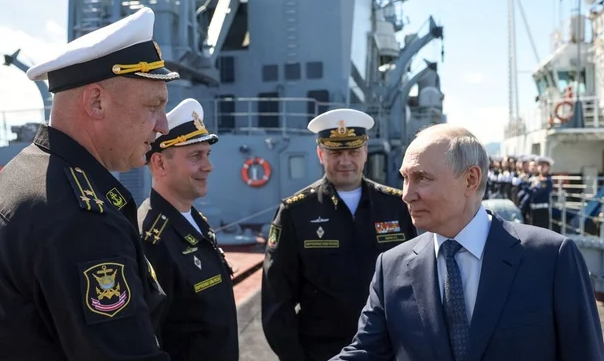
According to Russia's TASS news agency, Putin visited Iturup Island, known in Japan as Etorofu, on the 13th during a tour of Siberia and the Russian Far East. Iturup is one of the four southernmost islands at the center of the territorial dispute. The visit marked Putin's first trip to the islands since he came to power in 2000.
Putin inspected the flagship of Russia's Pacific Fleet and received a briefing on military exercises. He also toured a seafood processing plant, a hospital and a school, and spoke with local residents.
The last visit to the Kuril Islands by a Russian head of state came in 2010, when then-President Dmitry Medvedev traveled to Kunashir Island. Putin's trip was the second such visit by a Russian president.
Japan claims sovereignty over four islands north of Hokkaido -- Kunashir, Etorofu, Shikotan and the Habomai islets -- collectively referring to them as the Northern Territories.
The Soviet Union seized the islands shortly after the end of World War II in 1945 and expelled their Japanese residents. Russia has maintained effective control over them for more than 80 years.
Japan argues that although it renounced rights to the Kuril Islands under the postwar peace settlement, the four Northern Territories were not included in that renunciation.
At a press conference, Takaichi said, "The Northern Territories are an inherent part of Japan's territory under both international law and historical grounds." She added that a visit by a sitting Russian president "ignores the Japanese government's consistent position and hurts the feelings of the Japanese people."
Japanese Foreign Minister Toshimitsu Motegi also summoned Russian Ambassador to Japan Nikolai Nozdrev to lodge a protest.
◇ Why Now?... Attention Turns to Russian Domestic Politics
Japanese media have focused on why Putin chose to visit the islands now after avoiding such a trip for so long.
The Asahi Shimbun said Russia had previously refrained from presidential visits in order to preserve the possibility of resolving the territorial issue and to encourage economic cooperation with Japan.
The situation has since changed.
Russia sought to improve relations with the United States after the start of the second Trump administration and even held a summit in Alaska last August. But that meeting did not lead to follow-up talks.
The Nikkei cited fading prospects for easing Western sanctions through better ties with Washington as one factor behind Putin's decision to visit the Kurils.
Domestic political considerations may also have played a role. According to the Yomiuri Shimbun, around 60% of Russians favor peace negotiations, while Putin's approval rating has fallen from the 70% range to 65%. Support for the ruling party has also dropped into the 30% range.
With elections for Russia's lower house scheduled for September, some analysts believe Putin is emphasizing territorial sovereignty in an effort to consolidate his domestic support base.
Shinji Hyodo, a senior research fellow at Japan's National Institute for Defense Studies, told the Asahi Shimbun that the primary purpose of the visit appeared to be sending a message to the Russian public.
◇ Putin Openly Criticizes Japan's Sanctions... "Postwar Reality Must Be Recognized"
A day before visiting the Kuril Islands, Putin directly criticized Japan's policy toward Russia while in Yuzhno-Sakhalinsk.
He said Japan was imposing unilateral sanctions on Russia "without properly understanding the root causes of the situation in Ukraine."
Putin also made clear that Moscow had no intention of backing down on the territorial issue. He said the status of the Northern Territories was "a reality that emerged after World War II and is reflected in international documents."
AFP interpreted the visit as an attempt by Putin to remind Japan of the diplomatic leverage he still holds as Tokyo continues sanctions against Moscow.
Some analysts also see the trip as a response to concerns raised in the Takaichi government's first defense white paper released earlier this month, which highlighted growing military cooperation among Russia, North Korea and China.
◇ Japan Weighs Further Protest... Peace Treaty Talks Could Become Even More Difficult
The Japanese government is assessing Putin's intentions and considering additional measures.
The Yomiuri Shimbun reported that Tokyo is weighing whether to directly convey its regret to the Russian side.
Takaichi said, "The Japanese government has continued to do its utmost in managing relations with Russia even under difficult circumstances," but added that "this visit has made the long-term restoration of bilateral relations even more difficult." She also urged Russia to take the seriousness of the matter fully into account.
Last month, Takaichi reiterated that Japan's policy of seeking a resolution to the Northern Territories issue and concluding a peace treaty with Russia remains unchanged.
넥스트포스트 이종균 기자 jay@nextpost.co.kr


