






In the AfDB’s 2025 Africa Industrialization Index, Morocco scored 0.8415 on a scale of zero to one, narrowly ahead of South Africa’s 0.8396.
The ranking marks a symbolic shift in Africa’s industrial landscape. But the broader picture remains far less encouraging: Africa still accounts for less than 2% of global manufacturing output.
The index tracks industrial development across 54 African countries between 2010 and 2024.
Africa’s manufacturing value added rose 24% from $285 billion in 2020 to $351 billion in 2025. Yet that figure remains smaller than the roughly $366 billion in annual revenue generated by Germany’s Volkswagen alone.
Africa also accounts for just 1.4% of global manufactured exports. Manufacturing represents 10.8% of the continent’s gross domestic product, well below the global average of 16.5%.
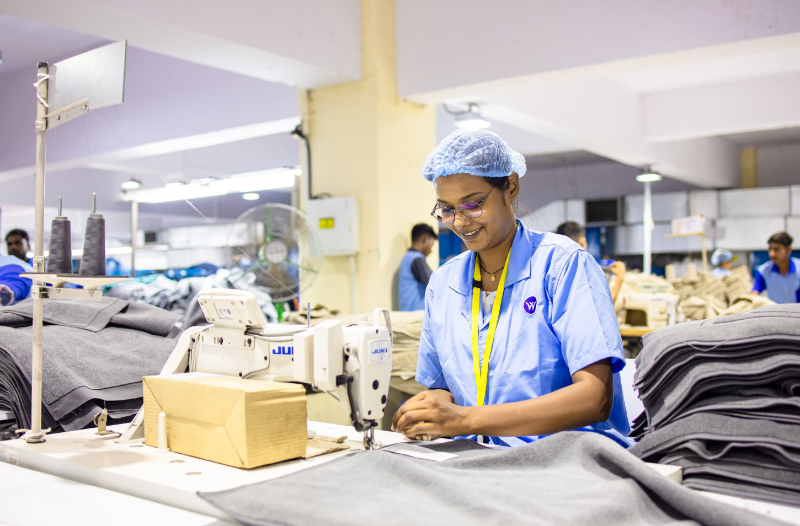
Kenya offers a clear example of why the gap has been so difficult to close.
Jaswinder Bedi, head of Bedi Investments, which has operated in Kenya’s textile industry since the 1980s, has warned that the country is steadily losing competitiveness as a manufacturing destination.
Manufacturing’s contribution to Kenya’s GDP has fallen from around 15% in the 1990s to 11% in 2010 and 7.2% today.
Over the same period, multinational companies including GSK, Bayer and Mondelez have shut down local production and shifted toward imports.
Electricity costs are among the biggest obstacles.
Industrial power prices in Kenya range from about $0.18 to $0.23 per kilowatt-hour, compared with $0.09 to $0.12 in Morocco, $0.09 to $0.19 in South Africa and just $0.01 to $0.02 in Ethiopia.
Low wages alone have also failed to deliver a decisive competitive advantage.
Kenya’s new minimum wage, announced in May, stands at about $150 per month, roughly one-third of the $450 monthly wage cited for Chinese workers.
But lower productivity means unit production costs can still be higher in Kenya, according to Bedi. He has argued that labor laws should shift toward rewarding output rather than simply time worked.
◇Special economic zones deliver mixed results
Special economic zones, promoted by governments across the continent as a vehicle for industrialization, have also produced uneven results.
The number of SEZs in Africa has risen from 20 in 1990 to 230 across 43 countries in 2025.
But a UN Industrial Development Organization review of 39 zones found that more than 40% were operating at less than 25% capacity. Only 15% were running at full capacity.
There are notable exceptions.
Morocco’s Tanger Med has successfully linked automotive manufacturing with logistics, while Mauritius’ Freeport and Ethiopia’s Hawassa Industrial Park have built stronger connections with logistics and textiles.
But many other zones suffer from weak integration with local industries, limited strategic coordination and structural inefficiencies. Roughly half are publicly owned.
◇A continental market still fragmented
Market size remains another major constraint.
The African Continental Free Trade Area is designed to turn much of the continent into a single trading bloc and encourage greater intra-African commerce.
Yet intra-African trade accounted for only 14.4% of total African trade between 2022 and 2024.
That compares with around 60% in Asia and 57% in Europe.
Non-tariff barriers such as customs procedures and sanitary standards are often cited as even more restrictive than tariffs themselves. Some estimates suggest they constrain intra-African trade by as much as three times more than tariffs.
At the same time, low-cost imports from China and India continue to put pressure on local manufacturers.
That has strengthened calls in parts of Africa for temporary protection of domestic industries until they are strong enough to compete globally.
◇The Dangote model draws renewed attention
Against that backdrop, the import-substitution model associated with Nigerian billionaire Aliko Dangote is attracting renewed attention.
In cement, Dangote pursued backward integration by securing access to limestone and controlling more of the production chain. The strategy helped transform Nigeria from a cement importer into a net exporter.
He later applied a similar approach to refining.
The $20 billion Dangote Refinery was built to reduce Nigeria’s longstanding dependence on imported refined petroleum products despite being one of Africa’s largest crude oil producers.
Dangote is now considering a refinery project in Kenya’s Lamu region that could process crude from Uganda, South Sudan and the Democratic Republic of the Congo.
Other African governments are moving in a similar direction.
Zimbabwe, Namibia and Ghana have introduced or pursued restrictions on exports of unprocessed strategic minerals such as lithium and cobalt, while encouraging or requiring more processing to take place domestically.
The underlying strategy is clear: instead of exporting raw materials and importing finished goods, African economies are trying to retain more value through local processing and manufacturing.
Morocco’s rise to the top of the AfDB industrialization ranking highlights how quickly Africa’s industrial hierarchy can change.
But the continent’s overall manufacturing footprint remains small.
Unless African economies can address high energy costs, weak productivity, underperforming industrial zones and limited intra-regional trade, gains by individual countries are unlikely to translate into a broader manufacturing breakthrough.
The central challenge is no longer simply producing more raw materials. It is whether Africa can build enough processing and manufacturing capacity to keep a larger share of that value within the continent.
넥스트포스트 이종균 기자 jay@nextpost.co.kr


